
Venice Carnival... a history behind masks

Venice Carnival
One of the most important features of Italian
Venice is its homes, water streets and transportation facilities that depend on
gondolas, but the most beautiful feature and uniqueness of
Venice is its carnival, which is the annual event, which is held every year forty
days before the glorious Easter and ends with the beginning of Lent.
Carnival story

It is said that the carnival began when the Kingdom of Venice (the former
name of
Venice) triumphed over the patriarch of Aquileia (Ulric) in 1162, and this event
was held in celebration and commemoration of the victory, people began to
dance and gather in San Marco Square (the most famous square in
Venice, which is a square covered by a bath). They wear masks that conceal their
faces.
It seems that this festival began at that time and became an official
celebration in the Renaissance, and this festival was cancelled during the
eighteenth century.
However, after a long period, it reappeared in 1979, when the Italian
government decided to revive the history and culture of
Venice, and made the revival and interest of the Carnival a starting point for
its plan.
Why do we hide with masks?

Being masked is a prerequisite for participating in the carnival, and it is
said that the reason for the existence of masks was to conceal the identity
of its owner and for the celebration to be popular does not differentiate
between the rich and the poor in a city of its basic (class) characteristic,
and it is also said that masks were found to conceal the identity of a
person in inappropriate places (bars and parties) Disrespectful), as they
cared about the image and the clean reputation as a higher class in society,
and masks are a special ritual of
Venice and not other cities in the world.
Masks are forbidden at all times, as permission is issued to wear them at a
certain date, which is between the festival of Saint Stefano’s Day and the
middle of the night of the beginning of the Carnival, and it is also
permitted from October 5 to Christmas Day, meaning that people spend a large
period of the year disguising their masks !!
Venetian masks are made of leather, porcelain, or processed glass
materials, and the original masks were simple in design and graphics and
often bear a specific symbol, while now most masks are made of gypsum and
gold patches, in addition to being painted with natural feathers and natural
colours and studded with precious stones, some of them with Swarovski.
What are the Venice Carnival masks?
There are five basic types of masks in
Venice, and they look different from the others.
Bauta

It is a traditional piece of art that covers the entire face with sharp
lines at the chin and without a mouth opening, while the nose is wide and
high to enable the person to speak, eat and drink easily without the need to
remove the mask, thus preserving the anonymity of the identity and the
outfit of the owner of this mask is often a cloak. Red or black and
triangular hat.
Colombina

|
| Venice Carnival... a history behind masks !! |
It is a half mask that covers the eyes only and is often encrusted with
gold, silver, crystal, or leather and is placed on the face through a stick
of the same colours, or using ribbons tied to the back as in most masks, and
this type of masks was designed for an actress who was working In the field
of comedy, because she wanted to show part of her face and not cover her
beauty complete with a mask, and on this basis, the mask was named after her
name, Colombina.
The plague doctor Medico della peste

The plague doctor mask with its long nose is one of the most well-known and
strange among the Venetian masks, and it is an amazing artistic design for a
horrific history !!
Doctor Carles de Lormi carried this mask as part of medical tools for
treating plague patients. The mask is white with large eye openings and a
long, tube-like nose, studded with crystal lobes, which gives him the effect
of a voyeur.
Now, this mask has become more decorated, and the plague doctors who used
the mask of the doctor, generally wear a black hat and a long black robe
with white gloves and sticks to move the patient without direct contact with
him so that the infection does not pass, and they took these precautions in
the hope that it would prevent transmission Diseases are due to them, and
clearly, we can notice the popularity of this mask during the carnival as a
commemoration of the plague doctor.
Moretta
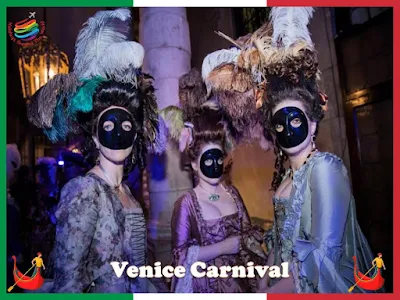
It is a stripless, oval-shaped mask that is worn exclusively by women of
the aristocracy and is fixed on the face by biting the woman on a button
fixed on it, which makes it remain silent, this mask has not been common
since 1790 AD.
Volto

It is a white-based mask and it is purely Venetian, worn with a cloak and a
triangular hat, it is also called larva, which is a Latin word meaning mask
or ghost, and as the first mask, the design of this type allows the mask to
breathe, eat and drink without the need to remove the mask and without
opening the mouth This mask is made of tarpaulin and is light and
comfortable for the situation, which makes it suitable for dancing and
social nights.
As for the mask makers, they are considered a social class in and of
themselves in
Venice, which is one of the highest classes and they have their own laws. A union
was established for them on April 10, 1436 AD that takes care of them and
their affairs as they are part of the city's history.
The prices of masks in
Venice range from 5 euros to 4,000 euros and masks are among the most expensive in
Venice, and some are encrusted with natural diamonds.

During the Carnival period,
Venice was visited by about three million visitors, and
Venice appears to be more crowded than at any other time. One of the most
important activities in the Carnival is a celebration of the most beautiful
mask contest and many plays that tell the history of the past era in the
history of
Venice.
Some masks may seem frightening and strange, but they are an inseparable
part of
Venice. Those who visit
Venice are no longer masked as if they did not visit it.